

The Colour That Poisoned a Generation: The Dark History of Green Dye
The Colour That Poisoned a Generation: The Dark History of Green Dye
There’s something timeless about green.
It’s the colour of rolling Irish hills, moss-covered stone, and the quiet resilience of nature itself. It’s no surprise that around Saint Patrick's Day, we find ourselves drawn to it—wearing it, celebrating it, embodying it.

The Author, St Patricks Day Nottingham, 2026.
But the story of green in clothing is not always as pure as the landscapes it represents.
In fact, one of the most brilliant greens ever created came with a deadly cost.
A Dangerous Discovery: Scheele’s Green
In 1775, Swedish chemist Carl Wilhelm Scheele developed a vivid green pigment made using copper arsenite. It became known as Scheele’s Green, and at the time, it was revolutionary.
Before this, green dyes were often dull, unstable, or expensive. Scheele’s Green was different—it was bright, affordable, and highly desirable. It quickly found its way into everything from wallpapers to clothing.
But there was one critical flaw.
It contained arsenic.
From Innovation to Obsession: Emerald Green
By the early 19th century, German chemists refined Scheele’s formula into an even more vibrant pigment known as Emerald Green (also called Paris Green).
This version—produced widely in Germany—was richer, more stable, and even more fashionable. It became the height of Victorian style. Dresses shimmered in striking emerald tones, artificial flowers glowed unnaturally bright, and green became a symbol of modernity and luxury.
But beneath the beauty, the danger intensified.

Victorian fashion plate, Godey’s Lady’s Book, c.1860s.
Beauty at a Cost: Victorian Women and Arsenic Fashion
Wearing green in the Victorian era could be hazardous.
The arsenic in the dye didn’t stay locked in the fabric. It could flake off, be inhaled, or even be absorbed through the skin—especially when mixed with sweat or worn for long periods.
One of the most widely cited cases is Matilda Scheurer, a young woman who worked with arsenic-laced green dyes. She died in 1861 after prolonged exposure, reportedly vomiting green fluid, with the whites of her eyes and even her fingernails tinged with the colour she worked with daily.
While not all wearers suffered such extreme outcomes, many Victorian women experienced symptoms ranging from skin irritation to chronic illness—unaware that their clothing was the cause.
The Invisible Victims: Factory Workers
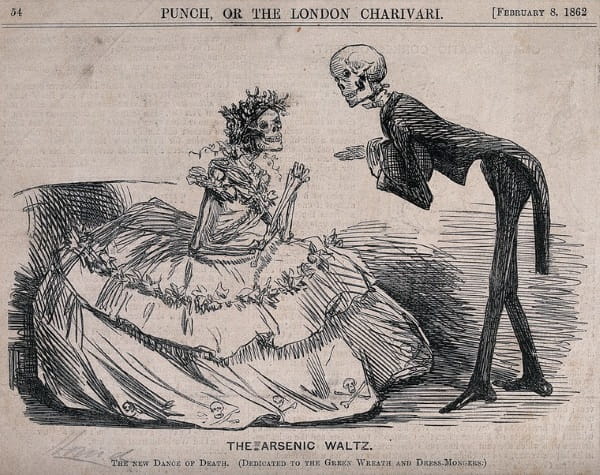
If wearing green was dangerous, making it was far worse.
Factory workers—often women and children—handled arsenic compounds daily with little to no protection. The pigment dust filled the air, settled on skin, and seeped into lungs.
Symptoms of arsenic poisoning were common: headaches, respiratory problems, lesions, and organ damage. In some cases, exposure proved fatal.
Yet demand remained high. Fashion, as it often does, moved faster than ethics.
The Turning Point: Regulation and Bans
By the late 19th century, the dangers of arsenic-based dyes became impossible to ignore. Public awareness grew, fuelled by medical reports and high-profile cases.
Gradually, these pigments were restricted and eventually banned across Europe.
At the same time, chemistry itself was evolving.
The accidental discovery of synthetic dyes—beginning with William Henry Perkin’s mauveine in 1856—ushered in a new era. Safer, more consistent, and easier to produce, these dyes marked the beginning of modern textile coloration.
From Poison to Progress: Dyeing Today
Today, the story of green has come full circle.
Modern dyeing techniques are shaped not just by colour, but by responsibility. The industry has shifted towards:
-
Low-impact synthetic dyes that minimise toxicity
-
Natural plant-based dyes derived from leaves, roots, and minerals
-
Closed-loop systems that reduce water waste and pollution
-
Certifications and regulations that protect both workers and the environment
Where Victorian fashion prized vibrancy at any cost, today’s approach increasingly values transparency, sustainability, and wellbeing.
A Colour Reclaimed
Green once symbolised progress, then danger, and now renewal.
As we wear it today—whether in celebration, craftsmanship, or connection to nature—it carries a layered history. One that reminds us how far we’ve come, and how important it is to consider not just how something looks, but how it’s made.
Because true beauty, like the landscapes that inspire it, should never come at the cost of life
References
Ball, P. (2001) Bright Earth: Art and the Invention of Colour. Chicago: University of Chicago Press.
David, A.M. (2015) Fashion Victims: The Dangers of Dress Past and Present. London: Bloomsbury.
Victoria and Albert Museum (n.d.) Textiles and Fashion Collection. Available at: https://www.vam.ac.uk (Accessed: 20 March 2026).
Smithsonian Magazine (2018) ‘The Secret History of the Color Green’. Available at: https://www.smithsonianmag.com (Accessed: 20 March 2026).